Skip to content
Snigdha OSDecentralized
Public ISO Released — Snigdha OS Decentralized 2026.11.13

An operating system that leaves nothing behind.

Snigdha OS Decentralized is an independent, privacy-focused live operating system built on Arch Linux — volatile by default, fail-closed on the network, and verifiable down to the signature.

Public ISO release published with cryptographic signatures & SBOM.Inspect verification status & checksums

Amnesic
Zero writes to disk
Fail-closed
No Tor, no traffic
Verifiable
Signed builds & SBOM
snigdha@live-session: ~ / i3wm-desktop
Snigdha OS Decentralized — i3wm Desktop
Phase 1 Verified

Modular i3 window manager with Everblush theme, Polybar indicators, and Picom blur.

Inspect subsystem

Product philosophy

Principles of sovereign computing

Snigdha OS Decentralized rejects empty security marketing. Eight foundational engineering principles drive the architecture and preserve user sovereignty under hostile conditions.

01Privacy by design

Privacy is not a secondary setting or optional extension. All system defaults prioritize metadata minimization, zero telemetry collection, and local cryptographic sovereignty.

Enforcement

Zero third-party trackers · no mandatory cloud accounts · randomized MAC addresses

02Network traffic protection

All external communications are mediated by strict kernel-level firewall policies. Packets must either route safely through Tor or be dropped fail-closed.

Enforcement

NetGuard nftables ruleset in table inet · Tor TransPort redirection · UDP leak drop

03Volatile sessions & amnesia

Sessions leave zero traces on the computer's physical storage. The root filesystem operates in RAM and disappears upon shutdown or emergency USB extraction.

Enforcement

RAM OverlayFS · tmpfs upperdir · swap masked to /dev/null · media removal watchdog

04User-controlled encrypted storage

Persistence is strictly optional and user-governed. When activated, persistent folders are isolated in an encrypted LUKS2 container unlocked only with explicit user consent.

Enforcement

LUKS2 with Argon2id memory-hard key derivation · selective bind mounts

05Application isolation & least privilege

Desktop applications are untrusted by default. Software runs confined within mandatory access control profiles and isolated unprivileged Linux user namespaces.

Enforcement

12 strict AppArmor enforce profiles · Bubblewrap containers · Seccomp-BPF filters

06Transparent security architecture

Security claims are backed by documented cryptographic models, public source code, verified test suites, and transparent operational boundaries.

Enforcement

Architecture blueprints · public test ledgers · unprivileged D-Bus telemetry

07Verifiable releases & open development

Every released ISO is deterministically reproducible from upstream sources, accompanied by detached OpenPGP signatures, SPDX 2.3 SBOMs, and SLSA v1.0 attestations.

Enforcement

ArchISO baseline profile · standalone snigdha-verify utility · pinned public keys

08Honest documentation of limitations

We reject marketing hyperbole. We clearly document what the operating system protects against, what it cannot protect against, and where physical hardware risks exist.

Enforcement

Residual risk disclosures: cold-boot DRAM attacks · X11 limits · traffic correlation

System subsystems

Modular security architecture

Every layer of Snigdha OS Decentralized operates under strict trust boundaries and explicit fail-closed guarantees. Explore each verified subsystem and the invariants that enforce it.

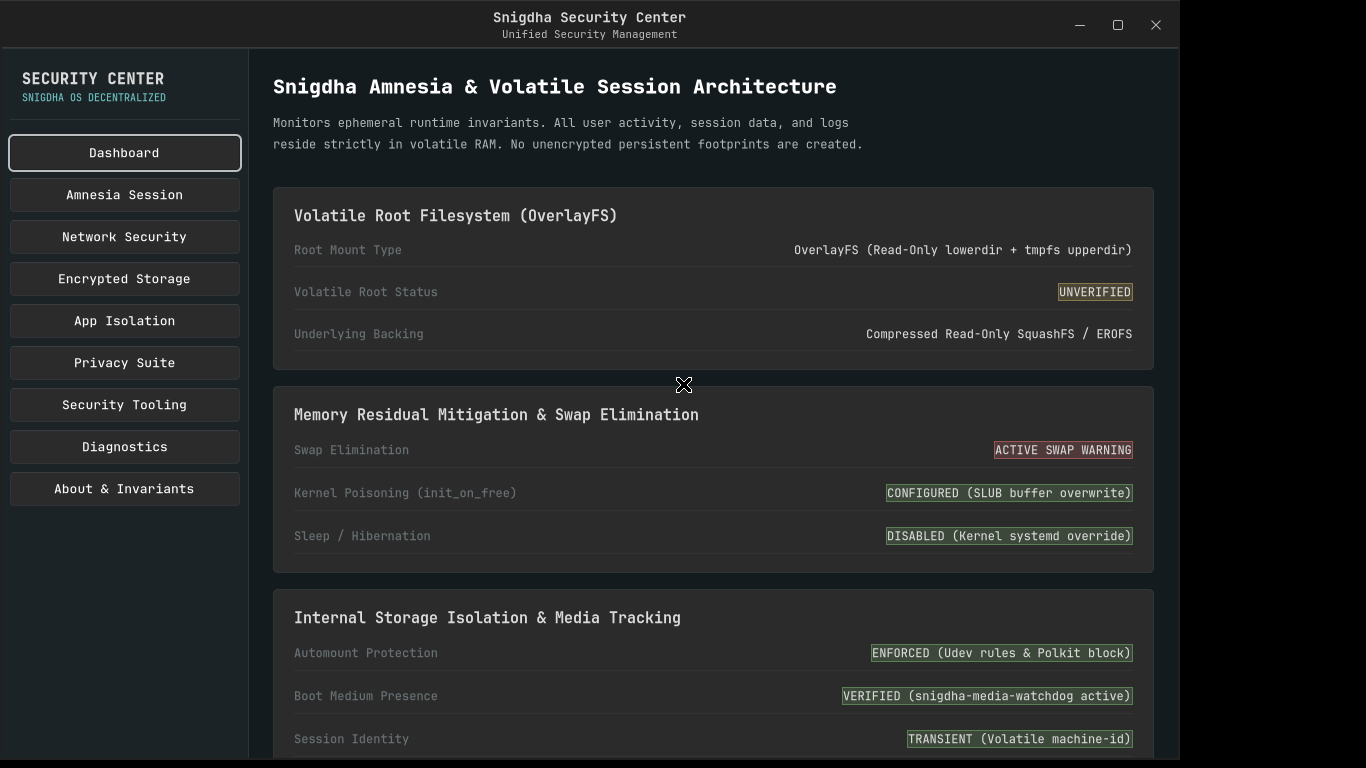
Snigdha Amnesia SubsystemPhase 2

Snigdha Amnesia Subsystem

Volatile memory execution leaving zero residual traces on internal disks.

Verified

All file writes, transient caches, and system modifications are directed to an in-memory tmpfs upperdir over a read-only dm-verity compressed erofs root. Internal storage devices are blocked from automounting, and all swap partitions are masked.

Architectural invariants
  • Read-only lower filesystem: airootfs.erofs
  • Volatile RAM upper layer: tmpfs
  • Hardware storage lock: UDISKS_AUTO=0 & Polkit restrictions
  • Media watchdog: clean amnesic shutdown on USB removal
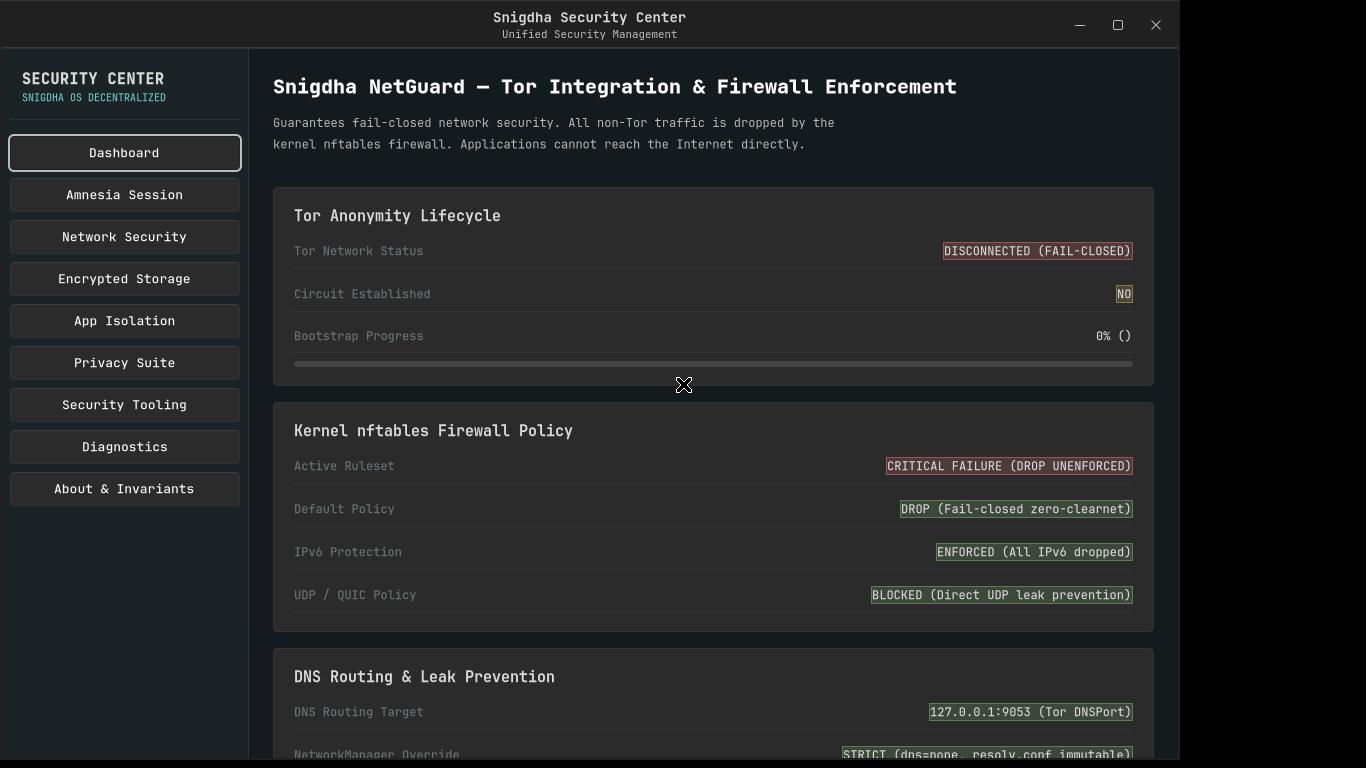
Snigdha NetGuard SentinelPhase 3

Snigdha NetGuard Sentinel

Fail-closed nftables routing with zero external cleartext packets.

Verified

NetGuard enforces transparent torification at the kernel packet filter level. Non-Tor TCP traffic is redirected to Tor TransPort (9040), DNS queries are redirected to Tor DNSPort (5353), and raw UDP is blocked to eliminate QUIC and WebRTC leaks.

Architectural invariants
  • Kernel table: inet snigdha with atomic ruleset loader
  • DNS leak interception: UDP 53 → Tor 5353; TCP 53/853 dropped
  • Kill switch: Tor startup lock until user authorization
  • Volatile bridges: obfs4 & Snowflake held strictly in RAM
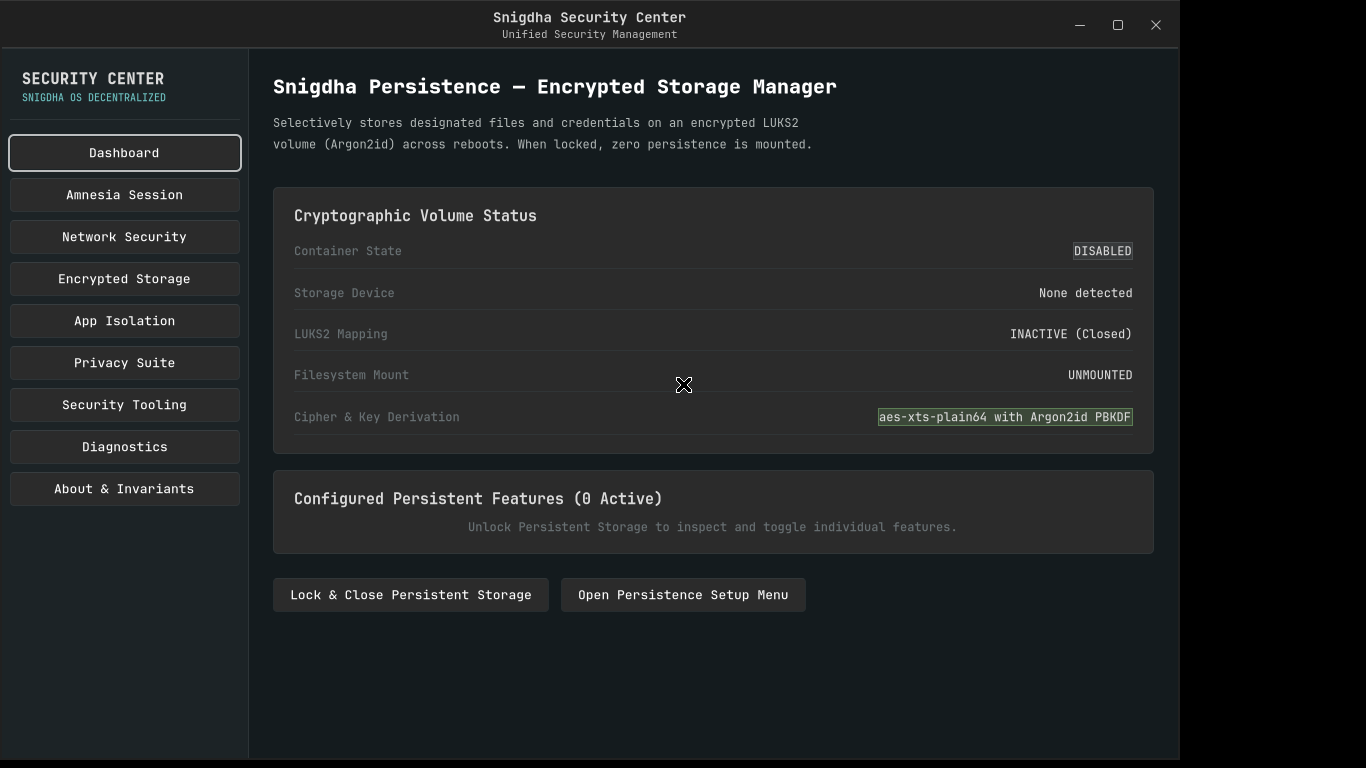
User-Controlled LUKS2 PersistencePhase 4

User-Controlled LUKS2 Persistence

Selective, cryptographically isolated storage on bootable media.

Verified

Persistence is disabled by default to maintain plausible deniability. When configured, an encrypted container formatted with LUKS2 and Argon2id key derivation houses user-selected folders via selective read-write bind mounts.

Architectural invariants
  • Cryptographic standard: LUKS2 with Argon2id memory-hard KDF
  • Modular feature bindings: GnuPG, SSH, NetworkManager, Tooling
  • Isolated bind mounts: /snigdha/persistence/{feature}
  • Clean teardown: late shutdown service flushes and unmounts
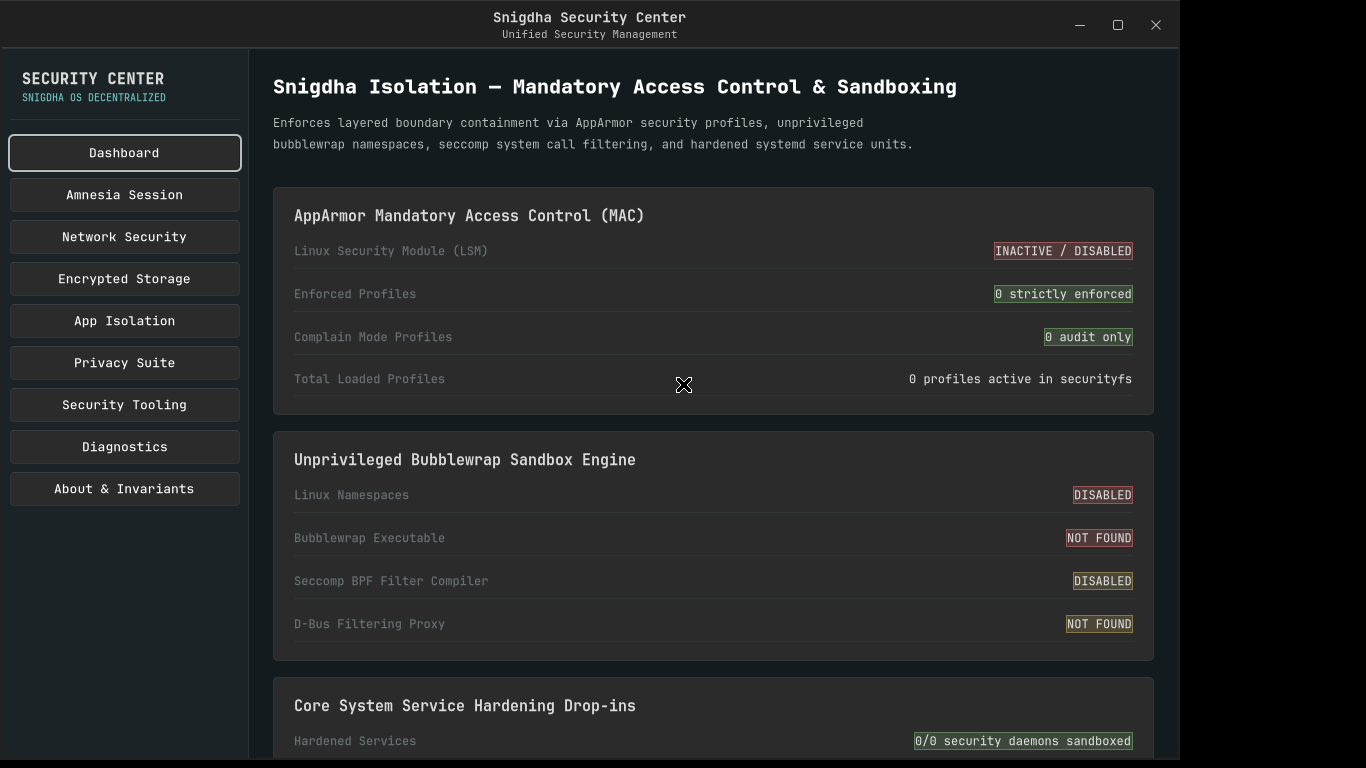
Application Isolation & MACPhase 5

Application Isolation & MAC

Strict enforce-mode AppArmor confinement and unprivileged Bubblewrap sandboxes.

Verified

Untrusted and high-risk applications run within strict confinement boundaries. AppArmor profiles block access to raw network sockets and device files, while Bubblewrap isolates user namespaces and temporary directories.

Architectural invariants
  • 12 dedicated AppArmor profiles running in strict enforce mode
  • Ephemeral Bubblewrap containers with private /tmp and masked storage
  • Native C Seccomp compiler attaching BPF system call filters
  • D-Bus message proxy rejecting privileged service calls
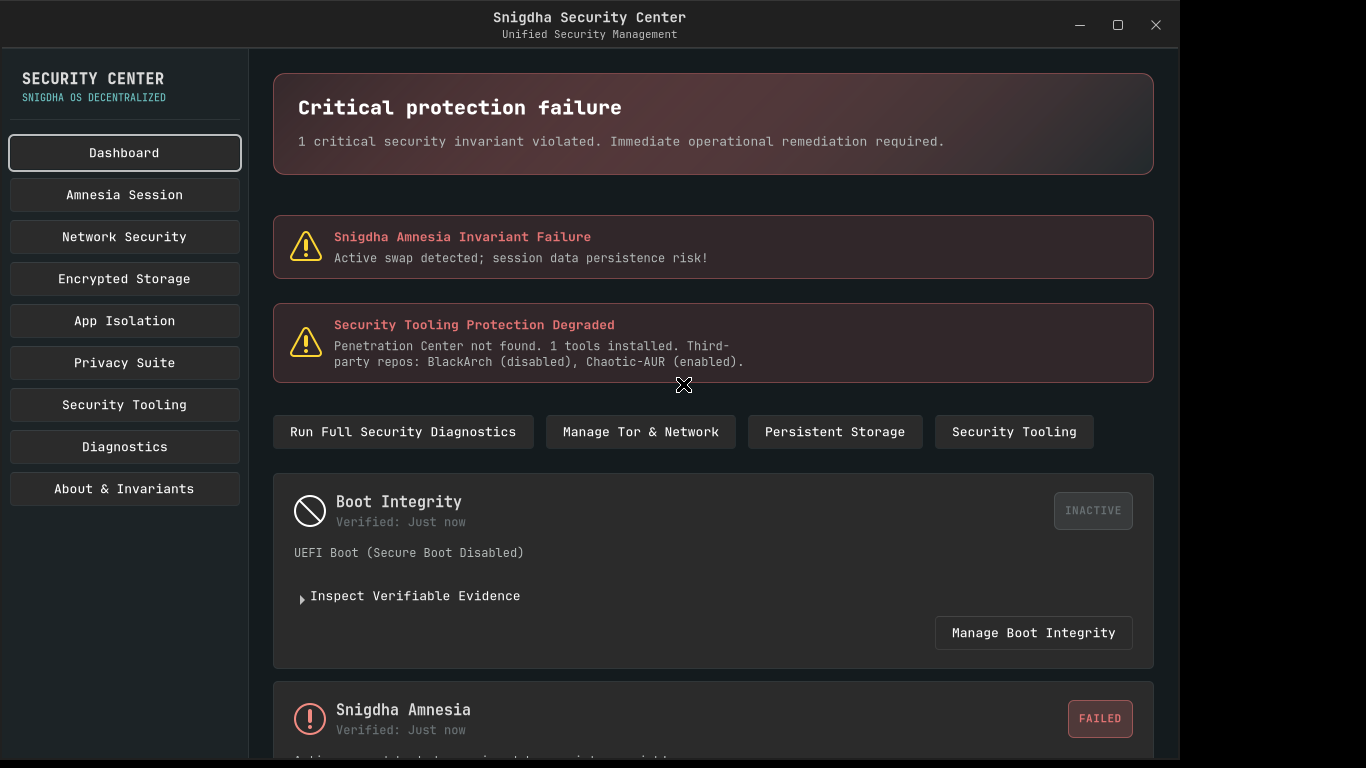
Native Snigdha Security CenterPhase 7

Native Snigdha Security Center

Real-time posture telemetry and diagnostics built with Rust & GTK4.

Verified

A native desktop application that aggregates live security posture into an Everblush-themed interface. Monitors NetGuard firewall rules, active Tor circuits, amnesic tmpfs consumption, and sandboxed processes without root escalation.

Architectural invariants
  • Compiled native binary: Rust + GTK4 + Libadwaita styling
  • Unprivileged telemetry: runs as UID 1000 over authenticated D-Bus
  • Interactive diagnostic runner with sanitized log export
  • 14 Rust integration tests verifying model and IPC integrity
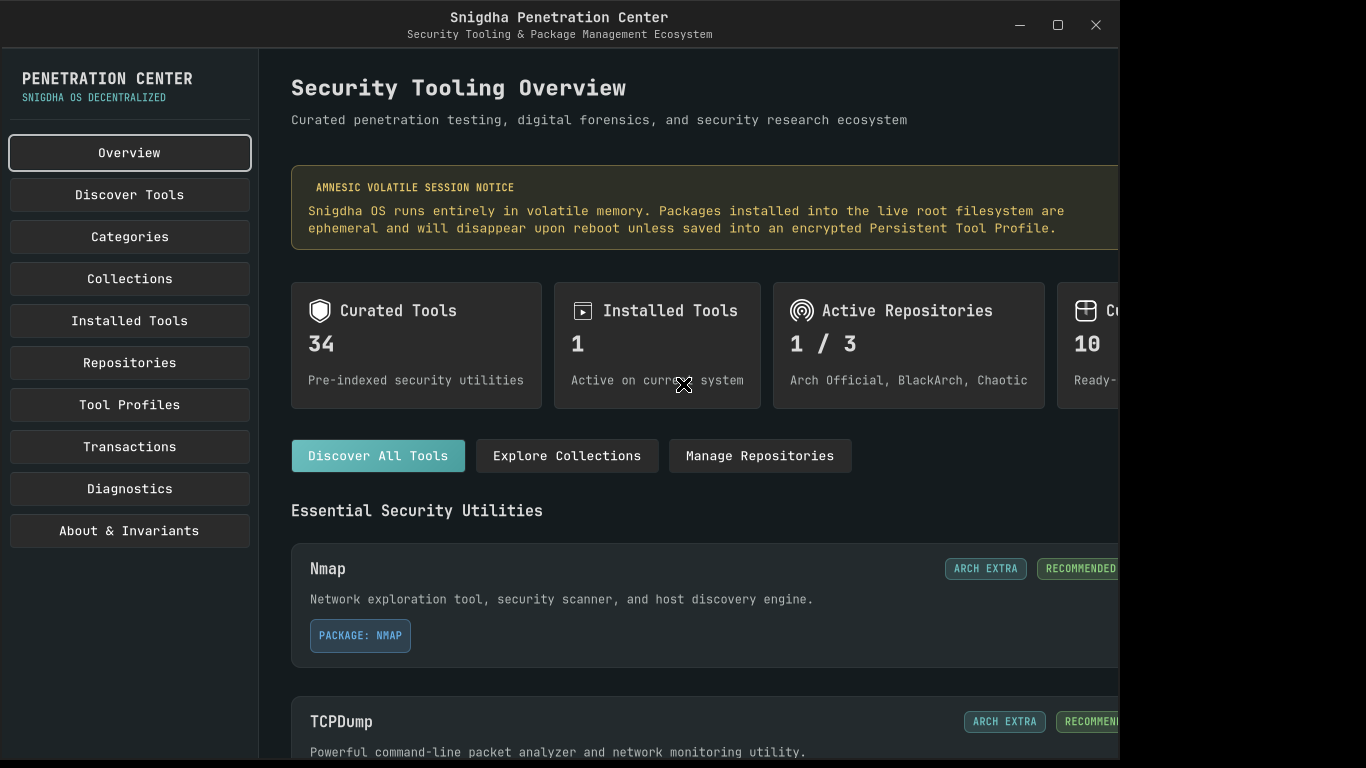
Snigdha Penetration CenterPhase 9

Snigdha Penetration Center

Curated security tooling ecosystem with unprivileged signature verification.

Verified

Unifies official Arch Linux, BlackArch, and Chaotic-AUR repositories while strictly enforcing that third-party repositories remain disabled by default, preventing partial upgrades, and verifying all cryptographic package signatures.

Architectural invariants
  • Native dual GUI and CLI binary in Rust
  • Strict policy: third-party repositories disabled by default
  • Mandatory OpenPGP package signature validation
  • Integrates with Phase 4 Persistence and Phase 7 Security Center

User experience

The Everblush desktop experience

A tailored, keyboard-driven environment engineered for speed, privacy, and visual coherence without unnecessary desktop bloat.

snigdha@live-session: ~ / i3wm
Snigdha OS Decentralized i3wm desktop session
Modular i3 window manager with Everblush theme

Built for focused, keyboard-driven operation

Every workspace is managed via precise tiling shortcuts. Picom provides subtle window depth and blur without high GPU overhead, while Dunst presents security alerts unobtrusively.

Keyboard-centric flow

Launch applications with Super+d, open terminals with Super+Enter, and manage NetGuard directly with Super+n.

Super+dSuper+EnterSuper+n

Live Polybar telemetry

Real-time bar modules display active Tor circuits, volatile tmpfs RAM usage, and LUKS2 container lock states directly on your primary monitor.

Everblush visual harmony

Cohesive color coordination spanning GTK2, GTK3, GTK4, Polybar, Rofi, Kitty, and the DedSec GRUB2 bootloader theme for eye comfort in low-light environments.

Included wallpapers

Custom bundled Everblush artwork optimized for dark workstations.

Mountain
MountainMinimalist geometric dusk peaks
Night
NightDeep obsidian starry atmospheric dusk
Retro
RetroEverblush retro-futuristic horizon
Patterns
PatternsClean cryptographic abstract lattice

Security ledger

Transparent trust boundaries

We document the exact state of every security mechanism. No marketing claims of “unhackable” or “100% anonymous” — only verified engineering.

View full threat matrix
Security domainSubsystemStatusArchitectural detail & limits
Mandatory Access Control (AppArmor)AppArmor LSMImplemented & VerifiedActive via `lsm=landlock,lockdown,yama,integrity,apparmor,bpf`. 12 dedicated profiles in strict enforce mode (flags=(enforce)). Zero complain mode in production.
Interactive Sandbox (Bubblewrap)snigdha-sandboxImplemented & VerifiedUnprivileged user, mount, PID, IPC, and UTS namespaces. Private volatile tmpfs, masked sensitive files, and restricted home storage.
System Call Filtering (Seccomp-BPF)snigdha-seccomp-compilerImplemented & VerifiedCompiles strict BPF bytecode attached at launch. Blocks ptrace, kexec_load, reboot, kernel module insertions, bpf, keyrings, and raw sockets.
Session D-Bus Filteringxdg-dbus-proxyImplemented & VerifiedFilters D-Bus messages, rejecting unauthorized calls to NetGuard1, Persistence1, and systemd1 with AccessDenied.
System Service Hardeningsystemd Drop-insImplemented & Verified9 drop-ins enforcing ProtectSystem=strict, PrivateTmp=yes, RestrictSUIDSGID=yes, ProtectKernelTunables=yes, and capability restrictions.
System-wide Tor EnforcementNetGuard nftablesImplemented & Verifiedtable inet snigdha nat_output redirects all non-Tor TCP to Tor TransPort (9040). Filter output chain drops non-redirected traffic. Fail-closed on Tor failure.
DNS Leak InterceptionNetGuard DNSImplemented & VerifiedUDP port 53 queries are redirected to Tor DNSPort (5353). Direct TCP DNS, DoT (853), and unauthorized resolvers are dropped fail-closed.
UDP & Leak EliminationNetGuard FirewallImplemented & VerifiedOutbound non-Tor UDP traffic dropped fail-closed (meta l4proto udp drop), eliminating QUIC bypass, NTP leaks, and WebRTC STUN leaks.

Honest disclosure: inherent hardware & protocol boundaries

Snigdha OS Decentralized explicitly acknowledges that no operating system running on commodity hardware can magically overcome compromised motherboard UEFI firmware, microarchitectural side channels (Spectre/Meltdown), cryogenic DRAM cold-boot capacitor retention, or global end-to-end traffic correlation. Review our comprehensive threat model before deploying in life-critical threat environments.

Independent · Open Source · Verifiable

Take control of your computing environment

Snigdha OS Decentralized gives you the architectural tools to operate privately — without surveillance, silent network leaks, or physical storage persistence.

BaseArch Linux LTS
Desktopi3wm Everblush
LicenseGPL-3.0
TelemetryNone